5 Ways AI Dashcams Are Revolutionizing Fleet Safety
1. Real-Time Driver Coaching, Not Just Recording
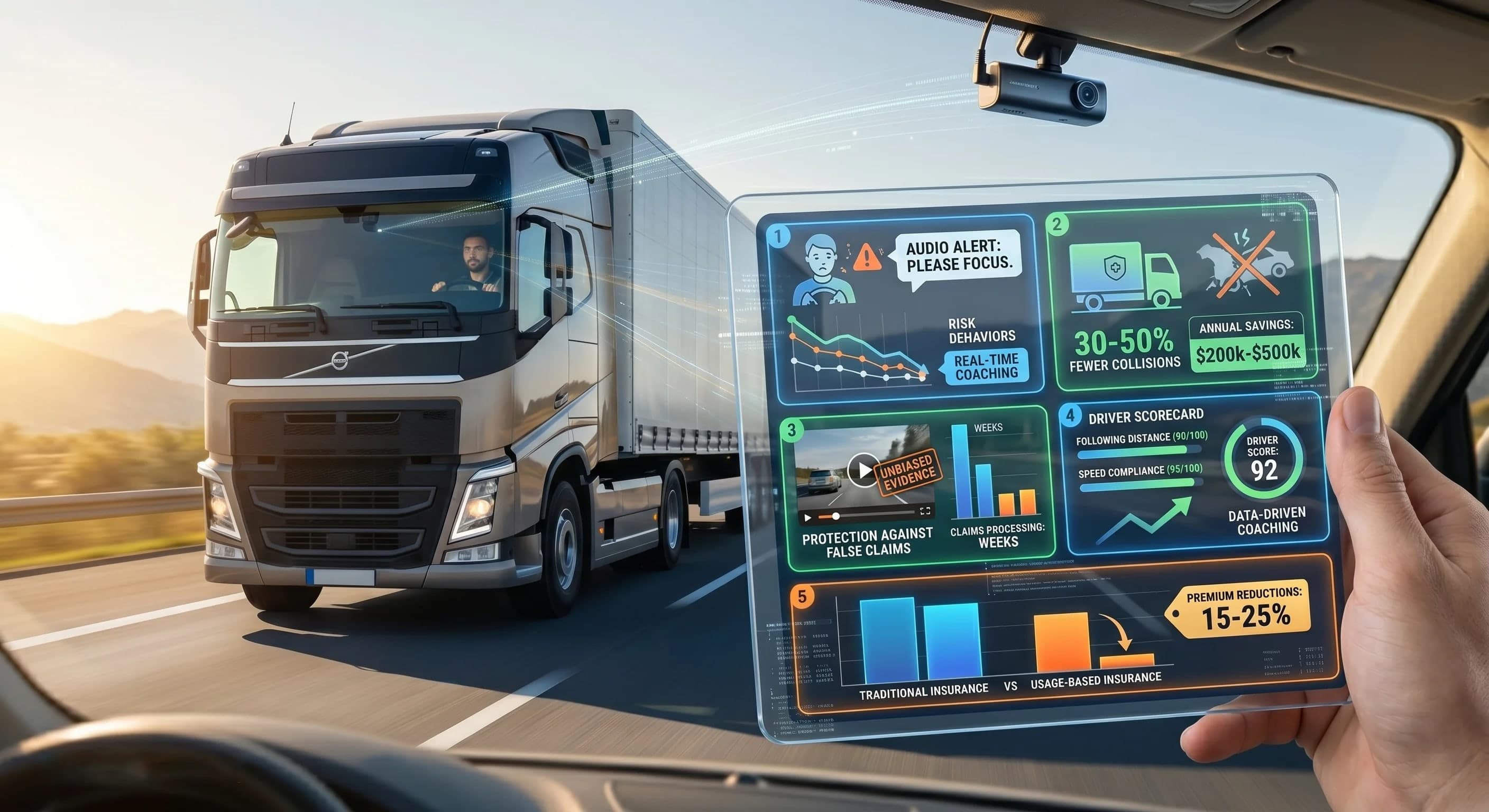
Traditional dashcams are passive — they record and wait for something to happen. AI dashcams flip this model entirely. Using computer vision, they detect risky behaviours as they happen: hard braking, tailgating, lane drifting, phone use, and even driver fatigue (eye closure, yawning).
Instead of waiting for a crash to review footage, the system issues an immediate in-cab audio alert — "Please keep your eyes on the road" — correcting behaviour in the moment. Over time, drivers form safer habits because the feedback is instant, not a lecture days later.
2. Dramatic Reduction in Collision Rates
Fleets using AI dashcams consistently report 30-50% fewer accidents within the first year. The reason is simple: when drivers know the system is watching and providing real-time feedback, they drive more attentively. The AI doesn't get tired, distracted, or frustrated — it monitors every second of every trip.
For a fleet of 100 vehicles, a 40% reduction in accidents can translate to $200,000-$500,000 in annual savings from reduced repairs, insurance deductibles, and downtime.
3. Protection Against False Claims and Litigation
Fault fraud and exaggerated claims cost the transportation industry billions annually. AI dashcams provide unbiased, time-stamped video evidence of every incident. When a claimant says a truck swerved into them, the video shows exactly what happened.
Beyond exoneration, video evidence often speeds up claims processing by weeks. Insurance companies settle faster when there's clear footage, and some insurers now offer premium discounts of 10-20% for fleets with AI camera systems installed.
4. Data-Driven Driver Coaching Programs
AI dashcams don't just flag bad driving — they quantify it. Each driver receives a safety score based on metrics like following distance, cornering force, speed compliance, andalertness. Fleet managers get a dashboard showing which drivers need coaching and which are performing well.
This transforms coaching from subjective ("I think you were speeding") to objective ("Your average following distance was 1.2 seconds yesterday, well below the 3-second target"). Drivers respond better to data than opinions, and safety scores improve 20-30% within 90 days of implementing a score-based coaching program.
5. Lower Insurance Premiums and Better Risk Assessment
Insurance is one of the largest operating costs for any fleet, and rates are climbing industry-wide. AI dashcam data gives insurers direct visibility into a fleet's actual safety performance rather than relying on historical loss ratios.
Fleets with AI dashcam programs are increasingly qualifying for usage-based insurance models, where premiums are tied to real driving behaviour rather than generalised risk pools. Early adopters report premium reductions of 15-25% — enough to fully offset the cost of the camera system within the first policy period.
Getting Started with AI Dashcams
Implementing AI dashcams doesn't require a fleet-wide overhaul. Start with a pilot on 5-10 vehicles, measure the safety score improvement over 30 days, and present the ROI to stakeholders. Most fleets see enough improvement in the pilot phase to justify a full rollout within 90 days.
FleetInfinity's platform integrates AI dashcam data alongside GPS tracking, fuel monitoring, and maintenance schedules — giving you a unified view of fleet safety and performance. Book a demo to see it in action.
More in Fleet Management Tips
Fleet Management Tips
Optimizing Fleet Efficiency in Extreme Climates: A Guide for GCC Transport Operators
Operating fleets in the GCC summers presents extreme temperature challenges. Learn how AC idling audits and hardware-agnostic offline buffering can secure your operations.
Read MoreFleet Management Tips
How India's Logistics Fleets Prevent Fuel Loss and Optimize Delivery Networks
Fuel represents up to 40% of fleet operating costs in South Asia. Discover how capacitive fuel sensors and offline sync help Indian logistics fleets safeguard their margins.
Read MoreFleet Management Tips
Launching a GPS Tracking Business in Morocco: White-Label Platform
The telematics market in Morocco is growing rapidly. Discover how to launch your own GPS tracking brand with custom web portals and OBD diagnostics.
Read MoreSee FleetInfinity in Action
Discover how our platform can transform your fleet operations.